
Engineered from premium seasoned Canadian Hard Rock Maple, kiln-stabilized roasted maple, and selected exotic tonewoods. Each neck undergoes computer-controlled dual-action truss rod calibration, laser-guided heel geometry profiling, and strict CE/RoHS material screening for effortless assembly and lasting acoustic stability.
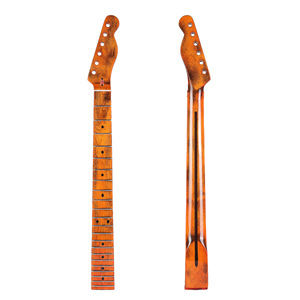
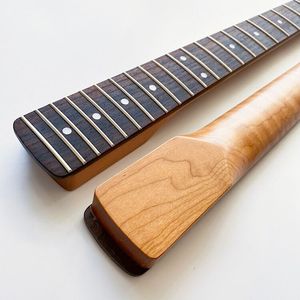
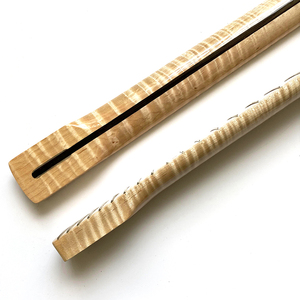
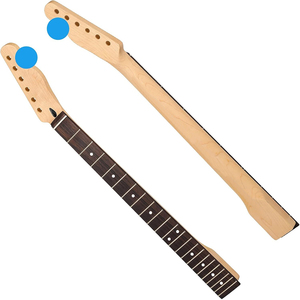
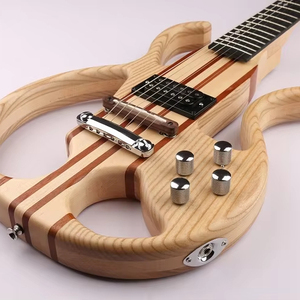
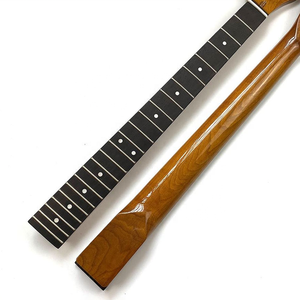
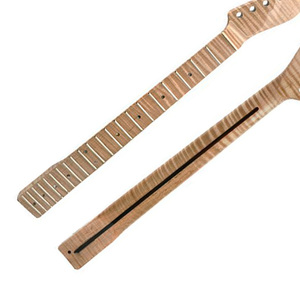
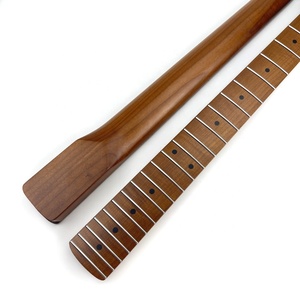
Drawing upon seven decades of luthiery oversight, exacting engineering protocols, and certified raw material sourcing, our bulk guitar neck production bridges artisanal playability with computer-automated industrial consistency.
Every polyurethane, nitrocellulose, and polyester finish applied in our dust-free cleanrooms undergoes strict spectrometer testing for lead, cadmium, phthalates, and VOC emissions, safeguarding distributor compliance across EU and North American markets.
By employing 5-axis synchronized robotic CNC milling, neck profiles (Modern C, Vintage D, Asymmetrical Slim) and compound fingerboard radii (9.5" to 14") are reproduced without geometric deviation across large batch runs.
We strictly procure North American Hard Rock Maple, quarter-sawn stock, and legally registered plantation alternatives. Every lot is paired with verified CITES non-restricted documentation to guarantee clean customs passage globally.
Raw blanks undergo 60-day acoustic conditioning followed by computerized dehumidification. Moisture content is stabilized at 8% to 10% before carving, actively preventing longitudinal twist and seasonal fret-sprout during transoceanic transit.
For tier-one guitar builders, assembly line efficiency depends entirely on pocket fitment and fret plane uniformity. Below is our engineering benchmark for OEM guitar neck assemblies.
| Component Specification | Industrial Benchmark Standard | Factory QC Tolerance Limit | Functional Impact on Final Assembly |
|---|---|---|---|
| Heel Pocket Width | 56.0mm (Standard ST/TL Spec) | ±0.03mm Max Deviation | Eliminates manual chiseling; guarantees drop-in body alignment. |
| Fret Level Planarity | PLEK Equivalent Laser Scanned | Sub-0.02mm across 22 frets | Allows buzz-free low action setup (1.2mm treble, 1.5mm bass). |
| Truss Rod Mechanism | Double-Action Steel/Titanium Core | Dual-Directional 180° Range | Compensates for extreme string tension changes and temperature shifts. |
| Moisture Content (EMC) | 8.0% - 10.0% Uniform Core | Tested via Pinless Capacitance | Guarantees dimensional stability across varying container climates. |
| Fret Tang Slotting | Blind Pocket / Semi-Hemispherical | 0.01mm Depth Consistency | Prevents fingerboard end-grain cracking and unsightly fret tang show. |
| Nut Slot Engineering | Pre-Radiused Flat / Curved Bottom | ±0.05mm Channel Width | Accommodates Bone, Graph Tech TUSQ, or Locking Nut drop-ins. |
By baking maple blanks at 180°C–210°C in an oxygen-deprived nitrogen environment, hemicellulose degrades, crystallizing internal lignins. The result is a lighter neck virtually impervious to humidity changes, exhibiting a rich vintage caramelized hue and heightened structural stiffness.
Where plain-sawn cuts have growth rings tangential to the fretboard (prone to lateral cupping), our select wholesale options utilize quarter-sawn timber with 60° to 90° grain orientation. This maximizes perpendicular flexural resistance under high string tension.
Beyond traditional 18% nickel silver fretwire, we provide OEM clients with micro-radius cryogenic stainless steel fret wire options. Crowned and rounded at 45-degree ball ends, our fret processing prevents edge sharpness and minimizes fret maintenance for years.
For instrument brands, procurement executives, and luthiery distribution networks, the next decade brings significant technical shifts. Aligning with these emerging standards ensures sustainable inventory margins and reduced customer returns.
Roasted maple has transitioned from an expensive boutique offering to a baseline expectation for midrange and professional instruments. Driven by unpredictable global logistics and climate extremes, torrefaction ensures zero shrinkage during container transit and reduces assembly-line warranty failure rates to near zero.
With ongoing scrutiny surrounding rosewood (Dalbergia) and ebony under CITES Appendix II regulations, high-density thermally treated Jatoba, Black Richlite composite, and roasted purpleheart are growing in OEM adoption. Sourcing these compliant materials protects trade channels from customs impoundment.
Modern players demand low action across chords and effortless bends past the 12th fret without fretting out. 9.5"-to-14" compound radius profiles combined with quick-adjust spoke wheel heel nuts are becoming the new industry standard, replacing headstock truss rod cavity designs.
Direct answers to the most common engineering, logistical, and customization questions asked by brand procurement managers and workshop heads.
Partner with an established manufacturer offering industrial precision, verified timber traceability, and rock-solid quality control. Speak directly with our international engineering desk to request CAD prototypes, test batch runs, or custom wholesale volume pricing.
Contact Us