
Explore our export-certified production models, custom roasted maple assemblies, replacement hardware, and verified accessories built to international trade standards.
A comprehensive examination of ergonomic guitar architecture, electromagnetic compatibility (EMC), multi-scale intonation, and European Union export compliance.
Modern commercial luthiery is witnessing an unprecedented transition toward headless guitar geometries. Traditional solid-body electric guitars maintain a structural vulnerability at the headstock-neck transition, particularly along the volute where grain orientation frequently diverges from the string pull vector. For commercial importers, freight handling insurance claims frequently trace back to headstock snapping caused by drop shock during container transshipment.
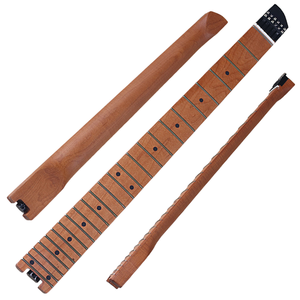
Headless guitars fundamentally eliminate this point of mechanical failure. By transferring the linear tuning assembly directly to the bridge unit, the overall instrument balance improves drastically. The center of mass shifts toward the player's core torso, alleviating clavicular stress and musculoskeletal fatigue during prolonged live stage performance and extended studio tracking sessions. Furthermore, total package length decreases by 15% to 22%, driving massive volume optimization in air and sea container consolidation.
From an acoustic perspective, the elimination of peghead mass yields a more linear fundamental resonant frequency across the fretboard. Dead spots commonly located on standard headstock designs at the 5th to 7th frets of the G-string are virtually mitigated. Utilizing dual-action steel truss rods integrated alongside high-modulus carbon-fiber stabilization bars, our export-grade headless necks withstand rapid relative humidity transitions across transatlantic and transpacific shipping channels.
International procurement teams frequently misinterpret the application of the European Union CE mark regarding fretted string instruments. In modern active and digital-integrated headless electric guitars, full compliance spans across multiple strict directives:
Forward-looking metrics and design paradigms that commercial distributors must integrate into forthcoming seasonal purchase orders.
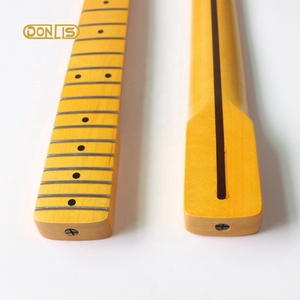
Distributors are prioritizing roasted Canadian maple. Vacuum-pyrolysis removes internal moisture, eliminating volatile terpenes and locking the cellulose structure against seasonal warping, slashing warehouse RMA rates down below 0.15%.
Modern down-tuning and progressive metal require graduated scale lengths (e.g., 25.5" to 25.0"). Fanned fret systems maintain crisp low-string tension without making high-register melodic bends excessively stiff for performers.
Transition from bulky cast baseplates to individual aircraft-grade CNC aluminum monorail bridge saddles. This design provides pure mechanical isolation between strings, diminishing cross-talk harmonics and optimizing dynamic response.
Quantifiable parameters comparing modern CE-compliant headless units against conventional commercial solid-body production runs.
| Functional Parameter | Standard Headstock Electric | CE Certified Headless Pro | Strategic Benefit to Wholesaler |
|---|---|---|---|
| Average Overall Length | 990 mm – 1020 mm | 790 mm – 825 mm | Reduces volumetric shipping charges by 20% |
| Tuning Stability Recovery | Dependent on nut friction & tree clips | Zero friction direct ball-end clamp | Decreased setup returns at final consumer retail |
| Truss / Reinforcement System | Single steel rod | Dual action + twin carbon rods | Resists extreme marine container humidity changes |
| EMC Shielding Level | Standard conductive paint | Ground-isolated copper cavity foil | 100% pass on EU EMC field emission inspections |
| RoHS Heavy Metal Thresholds | Occasional lead in bridge plating | Full lab certification per batch | Hassle-free clearance across Rotterdam, Hamburg, etc. |
Building instruments since 1956 in Nagoya, our technical background delivers unprecedented consistency for international brand holders and procurement syndicates.
Rooted in Nagoya's exacting manufacturing culture, our production runs strictly enforce multi-point inspection checkpoints covering neck relief, fret crown polish, bridge intonation, and electronic solder integrity.
Serving as an authorized exporter of world-renowned GOTOH precision guitar components and Augustine concert strings, our factory network benefits from deep industry connections, guaranteeing pristine hardware fitments.
Beyond instrument assembly, we provide authorized dealers access to extensive technical schematics, setup tolerances, and historical archive databases that build enduring brand authority and end-user trust.
Direct answers addressing technical compliance, minimum order quantities (MOQ), and shipping documentation for wholesale buyers.
Every production run undergoes random batch testing by accredited third-party labs. A formal Declaration of Conformity (DoC), along with XRF chemical testing documentation and EMC chamber results, is provided with final commercial shipping invoices.
For standard production runs of catalog headless models, our baseline MOQ starts at 50 units per colorway. Full custom ODM designs with specialized body carves or distinct pickup routings typically require a 100-piece commitment.
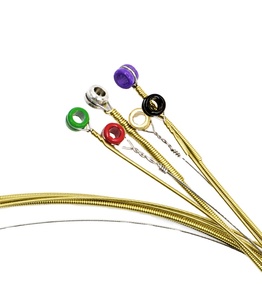
Yes. Our proprietary headpiece clamping lock systems are engineered to accept both double-ball-end strings and conventional single-ball electric guitar strings using hardened carbon-steel set-screws.
All export cartons are packed with high-capacity silica desiccants inside heat-sealed poly-liners. Wood moisture content is kiln-stabilized strictly between 8% and 11% prior to CNC milling, finish coating, and final assembly.
Absolutely. Leveraging our dedicated left-handed heritage catalog, bridge baseplates and headpiece assemblies are mirror-milled with zero structural compromise, allowing our distributors to meet specialty market demand effortlessly.
We supply an agreed-upon percentage of maintenance spare parts (including saddle rollers, locking nuts, bridge tuning gears, and potentiometers) free of charge with every full-container-load (FCL) order, supported by detailed technical schematics.