
Engineered under strict acoustic and electromagnetic benchmarks, our bass transducers and precision-machined audio connectors are designed to meet the rigorous thermal, chemical, and sonic expectations of commercial guitar builders, musical instrument distributors, and specialized warranty repair stations across Thailand and Southeast Asia.
The musical instrument production landscape in Southeast Asia has evolved from rudimentary sub-assembly services into a technologically mature ecosystem. In this new industrial hierarchy, Thailand stands at the operational center of regional guitar and bass manufacturing. Driven by the expansion of the Eastern Economic Corridor (EEC), streamlined logistics connections through Laem Chabang Deep Sea Port, and the concentration of high-skill woodworking facilities across Chonburi, Rayong, and Samut Prakan, Thai OEMs and boutique luthiers command substantial market share worldwide.
Despite access to first-grade tropical hardwoods—such as sustainably sourced sonokeling, padauk, and high-density local ash—electric bass builders consistently encounter an electronic performance bottleneck: inconsistent magnetic pickup components. An electric bass pickup functions as an inductive electro-acoustic sensor. It does not merely amplify string oscillation; it integrates the mechanical decay of the string, filtering out harmonic overtones based on core inductance, coil impedance, magnetic flux density, and distributed parasitic capacitance.
As a dedicated bass guitar pickups supplier and global exporter, our supply architecture addresses the specific demands of Thailand-based guitar assembly hubs, warranty depots, and regional music retail chains. By marrying high-volume coil repeatability with strict Japanese quality control benchmarks established by Aria Guitars since 1956 in Nagoya, our catalog bridges the gap between mass OEM production efficiency and hand-wound vintage authenticity.
Engineered with glass-fiber reinforced polymer flatwork and nitrogen-treated terminal eyelets. Resists internal winding oxidation caused by Thailand's 80%+ ambient humidity and coastal sea air.
Deep vacuum chambers force 80/20 paraffin-to-beeswax suspension deep into inner winding layers. Completely eliminates microphonic feedback across high-gain stage amps and live PA line-outs.
Precision-ground Alnico 5 and Anisotropic Ceramic 8 magnet rods generate a uniform magnetic aperture. Delivers instantaneous low-frequency transient tracking across slap, pick, and fingerstyle attack.
B2B buyers and technical directors must select transducer topologies based on verifiable electro-mechanical values rather than subjective tone terminology. Every pickup in our export assortment is built upon calibrated magnetics, pure 4N oxygen-free copper (OFC) wire, and precision-tooled bobbins.
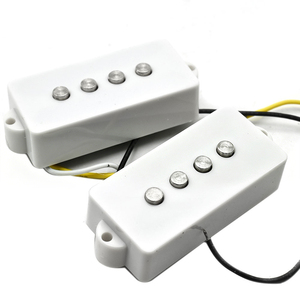
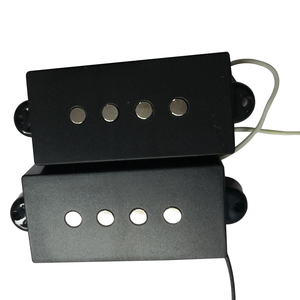
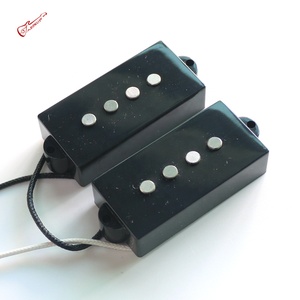
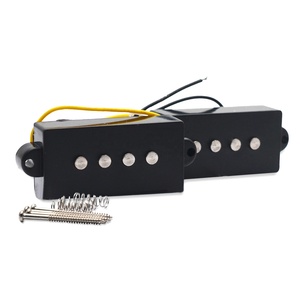
The split-coil Precision Bass configuration remains the dominant industry standard for modern band tracking and live broadcast. Utilizing two reverse-wound, reverse-polarity (RWRP) single coils wired in series, the system rejects common-mode 50Hz/60Hz alternating-current hum without compromising the low-frequency envelope.
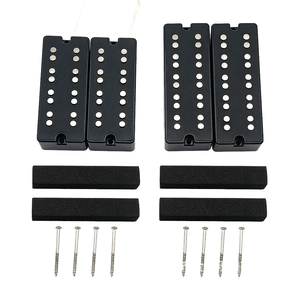
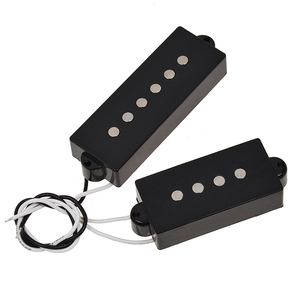
Models like our Donlis DP50 1-Set 4-String P Bass Pickup utilize staggered, hand-beveled Alnico 5 cylinder rods. By maintaining a moderate direct-current resistance (DCR) between 8.5kΩ and 9.2kΩ and an inductance value of 5.8 Henries, the DP50 generates a focused, percussive fundamental with immediate mid-range growl. For heavier musical applications, our Ceramic Magnet Black 5-String P Bass Pickup utilizes isotropic ceramic bar slabs paired with oversized steel polepieces, yielding high output (10.5kΩ+ DCR) that prevents the extended fundamental of the low B-string (30.87 Hz) from collapsing into muddy acoustic blur.
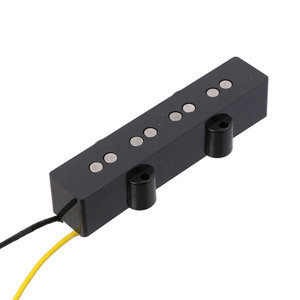
Where split-coil designs offer dense low-mid presence, Jazz Bass dual single-coil arrangements deliver wide dynamic frequency response and harmonic clarity. Our Wholesale Open Style 4 String Open Style J Bass Pickup with Ceramic Magnet provides immediate attack and sharp resonant peaks around 4.2 kHz. When coupled with our JB Bass Bridge and PB Bass Pickups Set PP-T70, players can blend the percussive attack of the bridge unit with the full-bodied low-frequency foundation of the split neck pickup, a configuration highly prized by contemporary jazz-fusion and session artists throughout Bangkok's live circuit.
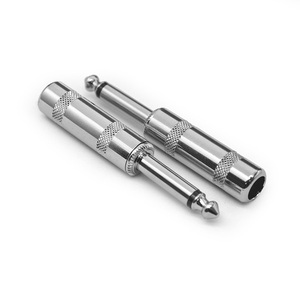
Signal degradation often occurs not inside the pickup winding, but at the output termination point. Instrument builders frequently lose signal clarity by pairing premium magnetic coils with low-cost zinc jacks. Our Factory Wholesale Durable Metal Steel Plastic Audio 6.35mm Jack Plugs feature solid nickel-plated steel contacts, high mechanical retention spring-steel sleeves, and high-dielectric nylon insulation. These jacks maintain solid 45-Newton contact grip under rigorous stage conditions, completely preventing grounding buzz and intermediate cutouts.
Procurement directors sourcing components for the Thai musical instrument ecosystem must navigate specific market conditions that distinguish Thailand from Western markets. Over the last five years, three prominent industry trends have emerged:
Throughout Northeast Thailand (Isan) and across urban concert stages in Bangkok, traditional folk genres (Morlam, Luk Thung) have fused with modern funk, reggae, and progressive rock. Bass lines in modern Morlam ensembles demand lightning-fast slap transients, clean upper-register fills, and extended low-end response to cut through intricate pin (lute) and khaen (reed organ) melodies. Builders catering to this vibrant touring sector heavily utilize our Two-Coil Open Two-Hole Four-String Bass Pickups and active-ready ceramic split-coils, which deliver the fast attack and cutting mid-range required for continuous festival use.
Thailand has witnessed an explosion of boutique guitar building workshops. Highly skilled craftspeople in Nonthaburi, Lat Krabang, and Chiang Mai produce high-end custom basses for international clients, utilizing indigenous Asian teak, rosewood, and mango wood tops. These boutique luthiers avoid generic mass-market components, prioritizing our Donlis DP50 Alnico 5 sets for their vintage DCR accuracy, authentic fiber flatwork styling, and vintage-spec cloth hookup wires that integrate seamlessly into high-end CTS-potentiometer control cavities.
Thailand’s tropical monsoon climate presents an aggressive test for electronic insulation. Relative humidity frequently surpasses 85%, while ambient performance temperatures on open-air stages routinely reach 38°C. Inferior pickups wound with low-grade enameled wire quickly suffer dielectric breakdown, layer-to-layer shorting, and internal mold corrosion. Our pickups are protected by a specialized high-melting-point microcrystalline and paraffin wax barrier that prevents moisture ingress, guaranteeing long-term impedance stability under extreme tropical heat and humidity.
For standard wholesale catalog models—including our DP50 Alnico 5 P-Bass, ceramic split-coils, and 6.35mm jacks—our minimum order quantity starts at just 50 units per SKU, facilitating manageable inventory cycles for regional distributors and luthier collectives. Factory dispatch takes 3–5 working days for in-stock components. Direct logistics to Bangkok (via air freight through Suvarnabhumi Airport) arrive in 2–4 business days, while ocean freight shipments bound for Laem Chabang Port clear customs within 10–14 days. Custom OEM custom winding projects require an initial 300-unit batch production cycle.
Every pickup is vacuum-potted in a specialized paraffin-microcrystalline formulation to seal the internal wire windings. The finished bobbins are hermetically enclosed in heat-sealed anti-static moisture-barrier polyethylene bags containing industrial activated-silica desiccant packets. Master shipping cartons are fabricated from double-wall 5-ply corrugated cardboard reinforced with an outer water-repellent film wrap to ensure zero moisture contamination during transit through humid tropical ports.
Yes. We offer complete OEM/ODM manufacturing services for commercial guitar brands. You can specify Alnico 2, 3, 5, or Ceramic 8 magnets, magnet wire insulation types (Heavy Formvar, Plain Enamel, or Polyurethane-coated), wire gauges (42 AWG, 43 AWG, or 44 AWG for over-wound high-output coils), custom polepiece spacing (ranging from 18mm to 20mm string pitch), and custom laser-engraved bobbin covers or brand markings.
Our bass guitar pickups and electrical hardware are exported under Harmonized System (HS) Code 9209.92 (Parts and accessories for musical instruments of heading 92.07: pickups, jacks, tuning machines). For Thai trade partners, shipments can utilize regional ASEAN trade certificate documentation (such as Form E or regional bilateral preferential certificates) to optimize or eliminate import duties under applicable international trade frameworks. Full commercial invoices, packing lists, and certificates of origin accompany every shipment.
Every single coil is wound on computer-controlled multi-spindle automatic traverse winding machines that maintain precise winding tension to within 0.05 grams, preventing internal wire stretching and irregular layer capacitance. Before wax potting, 100% of coils are checked on calibrated digital LCR bridges at 1 kHz to verify Direct Current Resistance (tolerance within ±1.5%), Inductance (in Henries), and Quality (Q) factors. Coil polarity (North-up or South-up) and winding phase (CW or CCW) are validated with Hall-effect magnetic flux sensors to ensure drop-in hum-free installation.
Partner with an industrial exporter backed by 70 years of Japanese musical instrument engineering standards. Access tiered wholesale pricing, OEM custom winding schedules, and rapid ASEAN delivery lines. Contact our B2B commercial desk to download our complete product catalog and component spec-sheets.