
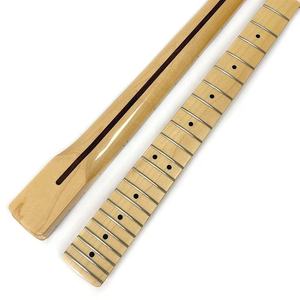
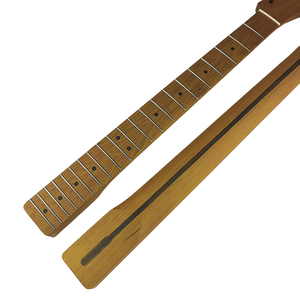
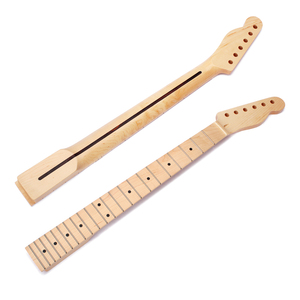
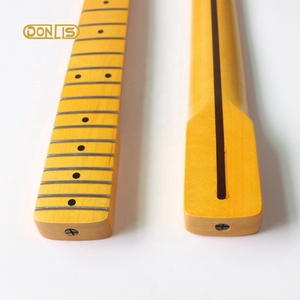
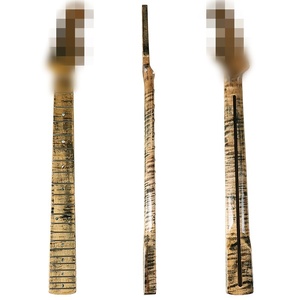
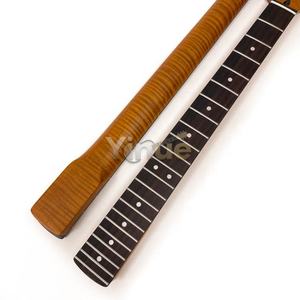
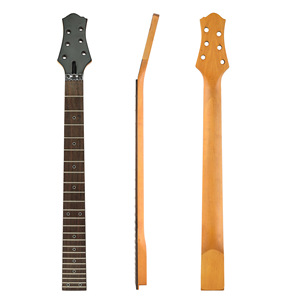
Engineered for drop-in compatibility, our necks feature select kiln-dried and torrefied Canadian rock maple, quartersawn construction, and master-grade fingerboards compliant with European import standards.
From the experimental recording studios of Kreuzberg to the master luthier workshops of Friedrichshain and Prenzlauer Berg, instrument builders demand guitar components adapted to distinct climatic and acoustic realities.
Berlin experiences extreme relative humidity (RH) differentials between indoor central heating environments in winter (dropping below 25% RH) and humid summer microclimates along the Spree (peaking above 75% RH). Conventional, green-sawn timbers quickly exhibit fret sprout, relief concavity, and heel warping under these stress cycles. As an industrial manufacturer supplying the German capital, our kiln-drying regimens run lumber through multi-stage thermo-treatment furnaces. This torrefaction crystallineizes hemicellulose inside our Canadian Rock Maple blanks, rendering necks chemically inert to ambient atmospheric shifts.
Boutique builders throughout Neukölln and Mitte require unbranded, pre-radiused necks with zero truss-rod latency. Our OEM supply supports compound radiuses (9.5" to 14"), allowing boutique assemblers to conduct final pleking and voicing without costly pre-truing passes.
Berlin is continental Europe's touring epicenter. Service stations and musical instrument retailers require drop-in, bolt-on necks adhering strictly to vintage 56mm Fender-standard heel pockets, ensuring 10-minute emergency swaps between festival dates.
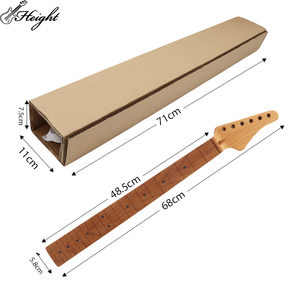
Specialized component shops and German e-commerce channels demand retail-ready blister packaging, uniform fret edge beveling (semispherical or 45-degree hand-dressed), and zero-defect fret seated tangs to protect consumer return margins.
Technical benchmarks for procurement managers, guitar factories, and distributor supply chain leaders targeting the German musical instrument landscape.
Roasted maple (thermally modified timber) has shifted from a boutique luxury to an industry imperative in Germany. By vaporizing organic moisture and resins at 190°C–220°C in oxygen-free kilns, necks gain a golden patina, reduced weight, and near-zero hygroscopic expansion.
German customs authorities in Hamburg and Frankfurt maintain stringent oversight over endangered species under CITES Appendix II. European procurement strategies emphasize sustainable alternate tonewoods like Pau Ferro, Blackwood Tek, and thermally modified Jatoba over restricted Dalbergia species.
Traditional vintage single-action compression rods can bind and leave neck relief non-adjustable during cold months. Berlin's professional players consistently demand spoke-wheel heel-accessible dual-action systems offering two-way correction without pickguard detachment.
| Dimensional Metric | Vintage Specification | Modern Standard (ST/TL) | High-Gain Shred Standard (24F) |
|---|---|---|---|
| Heel Width | 55.6 mm (2-3/16") | 56.0 mm ± 0.1 mm | 57.0 mm ± 0.1 mm |
| Heel Pocket Depth | 15.8 mm (5/8") | 16.0 mm | 16.0 mm (Countersunk) |
| Scale Length | 648 mm (25.5") | 648 mm (25.5") | 648 mm / 635 mm Conversion |
| Nut Width | 41.3 mm (1-5/8") | 42.0 mm (1.65") | 43.0 mm (Locking Nut Prep) |
| Fretwire Hardness | 160 HV (Nickel Silver 18%) | 180 HV (High Nickel) | 280+ HV (Jescar Stainless Steel) |
Combining seventy years of Japanese lutherie heritage with automated 5-axis robotic milling arrays, our facility supplies premier musical instrument groups, global distributors, and private-label programs.
Rooted in historic Japanese instrument design since 1956, our structural methodologies mirror the exacting standards forged across classical and solid-body production lines. Every profile is balanced for palm ergonomics, hand fatigue mitigation, and optimal tonal transmission.
Wood blanks are stored in dehumidified chambers for an average of 180 days post-kiln drying. Every guitar neck billet maintains a certified equilibrium moisture content (EMC) of 6% to 8% before running on CNC spindles, eliminating dimensional creep during ocean freight.
As authorized partners and exporters handling premier global brands like GOTOH guitar parts and precision string systems, our factory designs headstock tuner bores (8.5mm vintage vs. 10mm modern die-cast) with zero offset errors, ensuring rapid hardware mounting.
Essential trade details covering shipping to Germany, customs documentation, minimum order quantities (MOQ), and structural customizations.
Partner directly with an established high-tolerance manufacturing facility. Request our full OEM technical catalog, sample batches, and B2B volume pricing tailored for the Berlin market.